

Ever since the COVID-19 pandemic in 2020, the nature and method of work has significantly evolved. With the advancement of technology and collaborating tools, flexible working arrangement has gained prominence over the last few years.
In line with this shift, Malaysia amended the Employment Act 1955 to introduce Sections 60P and Section 60Q pertaining to flexible working arrangements (FWA).
However, there were still questions on how to adopt FWA in the workplace.
To address this, the Ministry of Human Resources released the Flexible Working Arrangement Guidelines (Guideline) in December 2024, offering guidance to both employers and employees on FWA in their work place.
In this article, we will be breaking down the Guideline and explore:
- The types of flexible working arrangements.
- The procedure to apply for flexible working arrangements.
- Employers’ duties under the Guidelines.
- Employees’ rights under the Guidelines.
Types of Flexible Working Arrangements
The Guidelines outline 4 types of FWA, namely:-
| FLEXIBLE WORKING HOURS Employees can choose their working and resting hours, provided they meet the total working hours in a day or week as determined by the employer. | FLEXIBLE WORKING DAYS Employees can reduce the number of working days in a week provided they meet the total working hours in a day or week as determined by the employer. |
| FLEXIBLE WORKING LOCATION Employees may work from home, remotely or report to office on specific days as determined by the employer. | Combination of any of these arrangements |
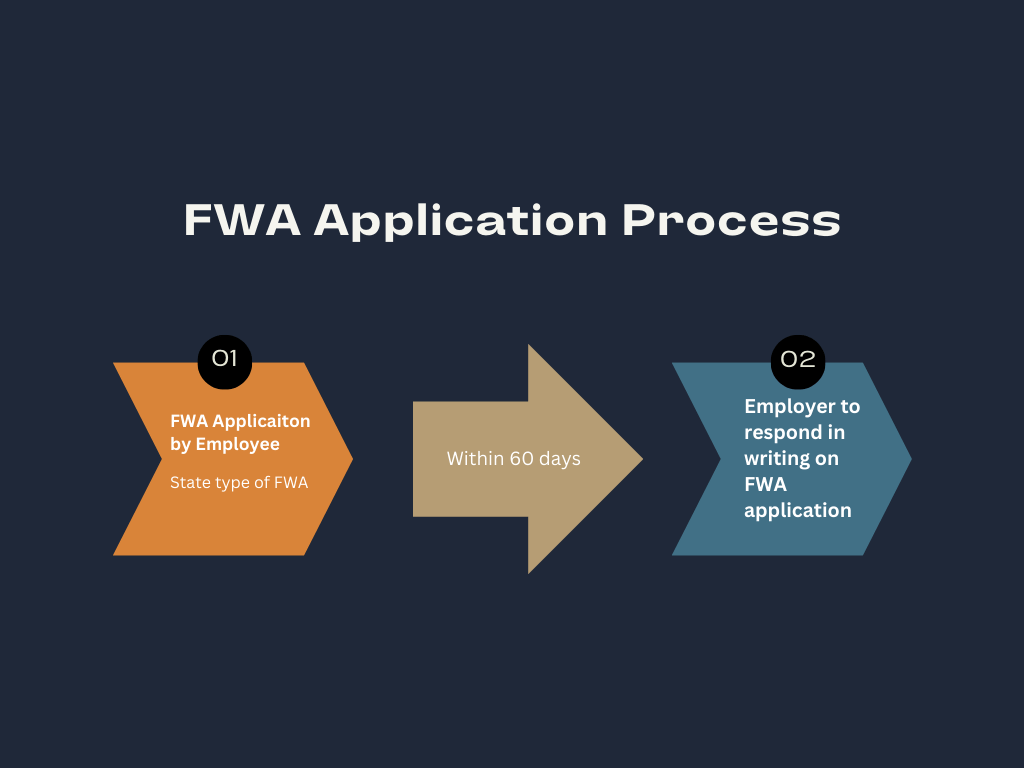
FWA Application Process
An employee who wish to apply for FWA may do so by submitting an application to their employer. A sample of the application form can be found in the Guidelines at pages 25 to 29.
Employees must inform their employer on the type of FWA they are applying for and provide reasons.
Once an employee makes an application, an employer must respond in writing within 60 days from receipt of the FWA application, either to allow or reject such application.
If an employer rejects the FWA application, the employer must provide reasons for his rejection.
If an employer approves the FWA application, the employer must:-
- State the duration of the FWA (either temporary, permanent or rotational)
- State the terms of the FWA which must be complied with.
- Establish a work monitoring and assessment system.
- Establish mode of communication between employer and employee.
The diagram below provides a concise overview of the FWA application process.
Employers’ Duties Under The Guidelines
An employer has several duties under the Guidelines:
- Employers are expected to evaluate the FWA application objectively and ensure there is no form of discrimination when considering the FWA application.
- If an employer rejects the employee’s FWA application, they must provide reasons in writing for such rejection.
- When establishing the terms for the FWA, an Employer cannot:
- Deny the employees statutory entitlements under the Employment Act 1955 such as leave, overtime, rest days, sick leave.
- Reduce or abolish existing benefits (e.g bonus, allowances) that is enjoyed by the employee.
- Increase the KPI.
- Employers are encouraged to set up an appeal system for employees in the event an FWA application is rejected.
- Employers are advised to keep all records and documents relating to the FWA application.
Employee’s Rights Under the Guidelines
Based on the Guidelines, employees applying for an FWA are entitled to certain types of protection or rights:-
- If an application is denied, an employer must provide reasons for the rejection to the employee.
- An employee may lodge a complain with the Labour Office in the event:
- The employer fails to respond to the FWA application within the 60-day period.
- The employer rejects the FWA application without giving cogent reasons.
- There is evidence of discrimination in the FWA application process.
- Not all job roles are suitable for FWA. Roles which require physical presence such as security guards, construction supervisors and assembly line workers may be ineligible for FWA.
Summing Up
The Guidelines introduced by the Ministry of Human Resource provides the much needed guidance on the application and implementation of FWA in Malaysia.
While employers retain the authority to approve or reject FWA applications, they are now subject to defined procedures and expectations.
For employees, the Guidelines provides a clear framework in applying for FWA and provides safeguards against discriminatory and arbitrary rejections of FWA applications.
Employers and employees should familiarise themselves with these guidelines to ensure a fair and transparent approach to FWA arrangements.
DISCLAIMER
This article is for informational and educational purposes only and should not be considered legal advice. For personalized guidance and advice, please consult a qualified lawyer.
 Tristan & Partners